
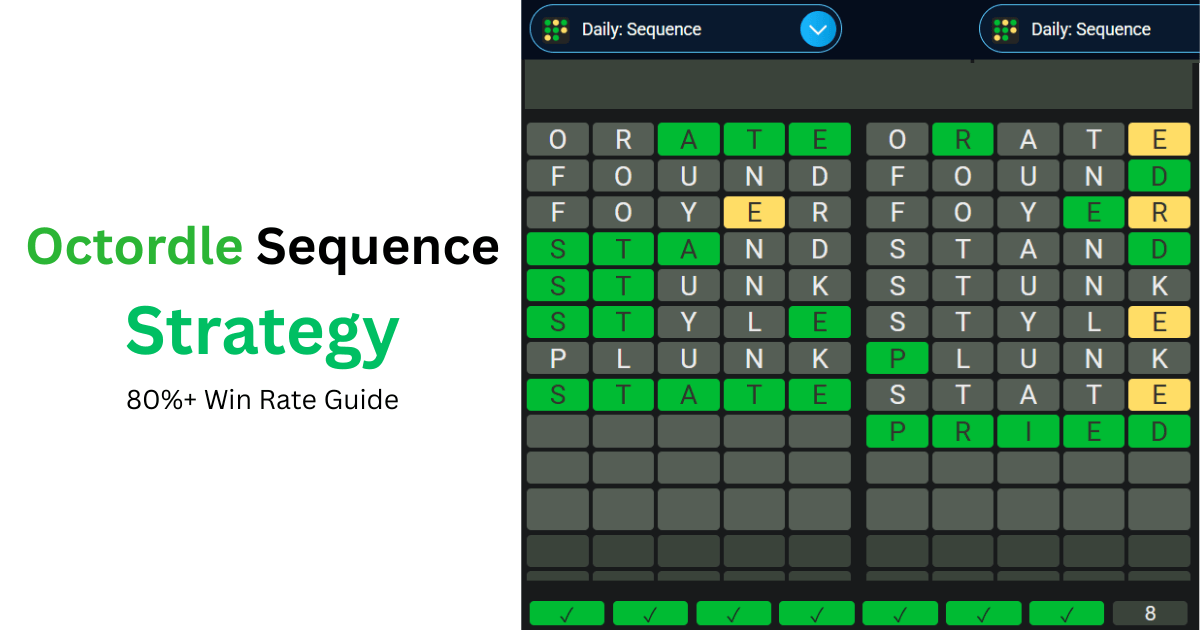
What Is Octordle Sequence Mode?
Your Octordle Sequence completion rate is stuck at 50-60%. You’re running out of guesses on word 7 every single time. The problem isn’t your vocabulary. It’s your pacing.
This Octordle Sequence strategy guide will jump you from 50% completion to 80%+ within 10 games using disciplined guess management across 8 hidden words. No tricks, just a system that actually works.
Unlike Classic Octordle game (where all 8 grids are visible and each guess applies to all boards simultaneously), Sequence forces you to solve each word completely before revealing the next one.
New to Octordle Sequence? Check today’s Octordle daily sequence answers to see what words you’re up against, or use this guide to develop the strategy to solve them yourself.
You can’t see what’s coming. You can’t strategize across multiple boards. Every guess is blind commitment.
This changes everything about strategy.
Coming from Wordle? Everything you learned there works backwards in Sequence. In Wordle, taking 5-6 guesses to be certain is smart play. In Sequence, it’s fatal. You’re not solving one word, you’re managing a budget of 15 guesses across 8 words you can’t see yet. Speed beats accuracy here.
How Sequence Mode Actually Works
Here’s what you see when you start a Sequence game:
Word 1: You see one empty 5-letter grid with a keyboard below. Make your guesses. When you solve it, you see “HORSE ✓” (or whatever the word was).
Word 2: The screen now shows “Word 1: HORSE ✓” at the top, and a fresh empty grid appears for word 2. Your previous guesses are gone. You start fresh.
This repeats 8 times. Each word is completely isolated. You can’t scroll back to see word 3’s letters while solving word 6. Once a word is solved, it’s locked away.
The only thing that carries forward is your mental map of which letters you’ve tested and where vowels tend to appear.
Octordle Sequence vs Classic
Before diving into strategy, you need to understand why Octordle Sequence demands a completely different approach than Classic mode:
| Feature | Classic Mode | Sequence Mode |
|---|---|---|
| Grid Visibility | All 8 grids visible from start | Only 1 grid visible at a time |
| Guess Application | Each guess applies to all 8 words simultaneously | Each guess only applies to current word |
| Information Flow | See feedback across all boards with every guess | Zero information about upcoming words |
| Strategic Focus | Optimize guesses across multiple boards | Speed and guess conservation per word |
| Total Guesses | 13 attempts for all 8 words | 15 attempts for all 8 words |
| Failure Point | Running out of guesses across all boards | Spending too many guesses on early words |
| Key Skill | Pattern recognition across grids | Pacing and commit speed |
The Critical Difference: In Classic, a “bad” guess still feeds useful data to 7 other boards. In Sequence, every guess is locked to one word with no visibility into what’s coming next. This is why you cannot afford to spend 3-4 guesses on word one. You’re gambling blind on having enough attempts for words six, seven, and eight.
This fundamental difference is why Classic strategies fail in Sequence mode. You’re not playing eight mini-Wordles. You’re playing a resource management game where time and guesses are your currency.
Sequence mode gives you 15 attempts to solve eight words one at a time. Sounds generous until you realize that’s less than two guesses per word.
The math is brutal. Spend three guesses on word one and suddenly you’re averaging 1.7 guesses for the remaining seven words. One expensive solve early means gambling on lucky guesses later.
Most players treat Sequence like Classic with training wheels. They take their time, play it safe, solve each word methodically.
Then word five arrives and they’ve used 11 guesses. Panic mode activates. The last three words become pure chaos.
Unlike Wordle or Classic Octordle, Sequence mode tests your speed and decision-making under pressure.
Quick Reference: The 8-Word Sequence Strategy
Pacing Guide:
- Words 1-4: 8 guesses total (2 per word max)
- After Word 5: Should have 5-6 guesses remaining
- Words 6-8: Use remaining attempts wisely
Starting Words: LOUSY → PRINK (covers all vowels by guess 2)
Golden Rule: Better to guess wrong early with 13 attempts left than solve methodically late with zero buffer.
Start Here: The Three Rules That Matter Most
If you only remember three things:
- Solve words 1-4 in 8 guesses total – Two guesses per word maximum. If you’re stuck on word 2, guess and move on. Running out of time on word 7 is worse than guessing wrong on word 2.
- Front-load vowels with LOUSY → PRINK – These map where vowels sit across all 8 words, not just word one. This pays off when you’re making split-second decisions on words 6-8.
- Check your pace after word 5 – You should have 5-6 guesses left. If you have 3-4, your problem isn’t the endgame. You’re spending too much time on early words.
Everything else in this guide explains why these rules work and how to execute them.
The 2-Guess Rule: Why Speed Beats Certainty on Early Words
Explanation (why Sequence is different): In Classic mode, a bad guess still feeds data to seven other grids. Sequence locks you into solving one puzzle with zero context about what’s coming. That yellow E you just found? Might be critical for word six. Might be useless. You won’t know until six guesses from now.
Why it matters (the consequences): If you haven’t solved a word by guess two, you’re already behind. Here’s what happens when you take three or four guesses on word one: You feel thorough and strategic. Word six proves you wrong. You’ve got five attempts left for three words and your brain is tired.
Force yourself to solve or make an educated guess by attempt two. This feels reckless. It’s actually disciplined. Better to guess wrong on word two with 13 attempts remaining than to methodically fail on word seven with no buffer.
Example (proof it works):
Guess 1: LOUSY
Result: L(gray), O(yellow), U(gray), S(green), Y(gray)
This tells you: O is in the word but not position 2, S is position 4
Guess 2: Based on O_S pattern with common letters: HORSE
Result: All green. Solved.
Even if HORSE was wrong, you move on. You’ve got 13 guesses left for 7 words.
Best Starting Words for Octordle Sequence
STARE and ADIEU are fine for Classic. They’re mediocre for Sequence.
You need coverage that matters across all eight hidden words, not just optimization for word one.
LOUSY covers all five vowels in one guess (L-O-U-S-Y). Your second word should test 5 new high-frequency letters. PRINK works perfectly (P-R-I-N-K hits 5 common consonants). So does CHANT, PRINT, BRING, or STORM. Pick whichever you remember easiest.
By guess 2, you’ve tested 10 letters including all vowels. This isn’t about solving word one. It’s about building a mental letter map that pays off when you’re making split-second decisions on words 6-8 with limited attempts remaining.
These aren’t the highest frequency letter combos. They’re vowel placement maps. By guess two, you know where U tends to appear, where O likes to sit, where vowel clusters probably exist.
This information pays dividends on words five, six, and seven when you’re making quick decisions with limited feedback.
Full Sequence Game Walkthrough (Real Example)
Here’s exactly what good pacing looks like across all 8 words. (Stuck on today’s puzzle? See today’s Octordle Sequence answers for hints, or follow this walkthrough to master the strategy.)
Word 1: Target = HORSE
- Guess 1: LOUSY → L(gray), O(yellow), U(gray), S(green), Y(gray)
- Guess 2: HORSE → All green ✓
- Guesses used: 2 | Remaining: 13
Word 2: Target = CHANT
- Guess 1: PRINK → All gray except N(yellow)
- Guess 2: CHANT → All green ✓
- Guesses used: 4 total | Remaining: 11
Word 3: Target = DWELT
- Guess 1: DWELT → Got lucky, all green ✓
- Guesses used: 5 total | Remaining: 10
Word 4: Target = GRIMY
- Guess 1: GRIMY → Wait, I tested most of these letters. Lucky guess ✓
- Guesses used: 6 total | Remaining: 9
✓ Checkpoint: Words 1-4 done in 6 guesses. Above target pace.
Word 5: Target = PLUMB
- Guess 1: BLURP → B(green), L(green), U(yellow), R(gray), P(gray)
- Guess 2: PLUMB → All green ✓
- Guesses used: 8 total | Remaining: 7
Word 6: Target = STAKE
- Guess 1: STALE → S(green), T(green), A(green), L(gray), E(green)
- Guess 2: STAKE → All green ✓
- Guesses used: 10 total | Remaining: 5
Word 7: Target = FROZE
- Guess 1: FROZE → This is why vowel mapping matters. Guessed it ✓
- Guesses used: 11 total | Remaining: 4
Word 8: Target = LIGHT
- Guess 1: LIGHT → All green ✓
- Final: 12 guesses used | 3 remaining
This is what proper pacing feels like. Notice how words 1-4 averaged 1.5 guesses each, leaving plenty of buffer for the endgame.
Top Starting Word Combinations for Sequence
Pick one combination and stick with it for 10 games:
Best Overall:
- LOUSY → PRINK (all vowels + most common consonants)
- ADIEU → STORY (vowel-heavy then consonant coverage)
Alternative Combos:
- ARISE → MOUNT (common letters, easy to remember)
- ROAST → CHIME (balanced frequency)
- SLATE → CRONY (Wordle player favorite adapted)
Don’t overthink this. Any combo that covers 10+ letters including A, E, I, O, U will work. The key is using the SAME combo every game so it becomes automatic. You can’t afford to waste 20 seconds deciding your opener when you’re on word 6 with 4 guesses left.
When Word Three Has You Stuck
You’ve got two yellows and one green. Seven possible words fit the pattern. No way to narrow it down without burning attempts.
This is the trap. You start testing: GRIEF, BRIEF, CHIEF.
Stop.
Pick one based on letter frequency and commit. If you’re wrong, you’re wrong. You still have 10+ guesses left.
The players who fail Sequence aren’t the ones who guess wrong on word three. They’re the ones who spend four attempts trying to be certain when certainty isn’t available.
Octordle Sequence Vowel Strategy
Standard advice says spread your guessing. Test consonants, map the word gradually.
Sequence rewards the opposite approach.
Get your vowels placed in the first two guesses even if those guesses can’t possibly be the answer. Once you know the A is position two and the E is position four, consonants fill themselves in naturally.
Words with ambiguous consonants but clear vowel patterns solve faster than words with known consonants and floating vowels.
Words Five Through Eight Are Different Puzzles
By word five, your mental starter word list is exhausted. CRANE, SLATE, FIGHT, ROUND. The obvious words are gone from your thinking.
Your brain reaches for vocabulary. QUALM, ZESTY, FJORD. Trying to be clever.
The algorithm doesn’t care about your SAT prep. It picks boring words.
Keep a mental category of “words I never remember”: SHRUG, DWARF, PLUMB, SWEPT. These show up in late Sequence words constantly because they’re common but unmemorable.
How to Know If You’re Actually Improving
Most players can’t tell if their strategy is working because they only track one thing: did I finish or not?
That’s useless feedback. You need checkpoints.
After Word 4: Count your remaining guesses. You should have 7 or more left. If you’re at 5-6, you’re playing too safe early. If you’re at 9+, you’re either guessing recklessly or getting lucky, neither is sustainable.
After Word 5: This is the breaking point. Good players have 5-6 guesses remaining. Struggling players have 3-4. If you consistently hit word 6 with fewer than 4 guesses left, your problem isn’t the endgame. It’s words 1-5.
Total guess count matters more than completion. A player who completes 70% of games averaging 12 guesses per completion is better positioned than someone completing 60% at 14 guesses. The first player is close to breaking through. The second is grinding with no margin for error.
Track these numbers for 10 games. If your “guesses used through word 4” average is above 9, that’s your problem. Not vocabulary. Not bad luck. Pacing.
The Five Guesses Left Breaking Point
Word six solved. Two words remaining. Five attempts left.
Good players slow down here. They write out what they know. They double check the keyboard for grays.
Bad players speed up. They’re so close to finishing that they start guessing instead of thinking.
This is where 75% of Sequence games are lost. Not on hard words. On simple mistakes made while rushing.
If you’ve got five guesses for two words and your completion rate is below 70%, your problem isn’t strategy. It’s pace.
Already Stuck? Emergency Recovery Tactics
You’re at word 7 with 3 guesses left. Here’s how to salvage it:
Ignore yellows, trust greens. If you have two green letters and three yellow letters, build your guess around the greens only. Yellow letters are nice-to-haves when you’re low on attempts.
Guess the boring word, not the clever word. Your brain wants to guess QUALM or ZESTY. The algorithm picked PLUMB or SHRUG. Common beats creative when you’re desperate.
Use your last guess on a word you’d say out loud. If you’re down to one attempt: would you use this word in conversation? If no, pick something simpler. SWEPT beats SLEPT beats CREPT when you’re guessing blind.
Accept strategic failure. If you’re at word 7 with 2 guesses and you’re completely lost, make your best guess and move to word 8. Better to have 1 attempt for word 8 than 0 attempts for both words.
Pattern Carryover Nobody Mentions
Sometimes word two has a double letter. Then word four has a double letter. Then word six does too.
This isn’t coincidence. The daily Sequence pulls from themed word pools more than random generation.
When you spot a structural pattern in early words, expect it to continue. Three words with consonant clusters probably means word seven has one. Two words ending in E probably means word eight does too.
Use this. On word seven, if you’ve seen repeated letters in four previous words, test for doubles even without direct evidence.
Why You’re Failing Octordle Sequence (And How to Fix It)
Most Sequence losses follow the same script. Recognize these and you’ll catch yourself before it’s too late.
You spend three guesses on word one. Feels thorough. Feels smart. But now you need to average 1.7 guesses per remaining word. The math already broke.
The Fix: Set a 90-second timer on your phone for each of the first 4 words. When it buzzes, make your best guess and move on even if uncertain.
You slow down at word six instead of speeding up. You’re close to finishing, so you get careful. This is backwards. Word six should take 90 seconds max. You need that time for words seven and eight.
The Fix: After solving word 5, stand up and stretch for 5 seconds. This resets your brain. Then attack word 6 like it’s word 2, fast and decisive.
You test four variations of the same pattern instead of guessing once. GRIEF, BRIEF, CHIEF, THIEF. Stop testing. Pick one. Testing is how you burn five attempts learning nothing.
The Fix: When you identify 3+ possible words, write them down on paper. Close your eyes. Point at one. That’s your guess. Sounds silly, works perfectly.
These aren’t strategy failures. They’re discipline failures. You know what to do. You’re just not doing it fast enough.
The Expensive Word Decision
Word four is a disaster. You’ve used six guesses and haven’t solved it. Two attempts left for this word alone.
Here’s the choice: Keep fighting for word four or intentionally fail it to preserve attempts for words five through eight.
Most players can’t make themselves quit. They’ve invested six guesses. They want to finish it.
The math says otherwise. Failing word four after eight total guesses but solving words five through eight cleanly beats solving word four on guess nine and having no buffer for the endgame.
Know when you’re throwing good attempts after bad.
What Actually Distinguishes 80% Completion from 50%
It’s not vocabulary size. I’ve watched people with ordinary word knowledge complete 85% of Sequences.
It’s commit speed. The time between seeing feedback and making the next guess.
Players stuck at 50% completion spend 30 seconds analyzing after each guess. They’re trying to be thorough.
Players at 80% spend five seconds. They’ve already decided the next two guesses based on likely outcomes before they even see the colors.
Track This Stat: After 10 games, count your average guesses used on words 1-4. If it’s above 9, you’re going broke early. Target 8 or less.
This Octordle Sequence strategy has helped players improve completion rates from 50% to 80%+ within 10 games.
Your Octordle Sequence Game Checklist
Print this or screenshot it:
Before Starting:
After Word 2:
After Word 4:
After Word 5:
Word 6-8 (Endgame):
5 Mistakes That Kill 90% of Sequence Games
Before we wrap up, here’s what’s actually causing your failures:
- Taking 3+ guesses on word 1 or 2 → Leaves 1.7 guesses per remaining word
- Slowing down on word 6 → You need speed here, not caution
- Testing pattern variations → GRIEF, BRIEF, CHIEF wastes 3 guesses learning nothing
- Forgetting vowel positions from early words → Your LOUSY/PRINK data pays off words 6-8
- Treating all 8 words equally → Words 1-4 get 2 guesses max; words 6-8 get the buffer
If you recognize yourself in 3+ of these, you don’t need more strategy. You need to follow the strategy you just learned for 10 games straight.
The Mistake You’re Making Right Now
If your completion rate in Sequence is below 65%, you probably know enough strategy already.
Your actual problem is treating every word like it deserves equal effort.
Word one, two, and three should each take two guesses maximum. Word four and five should take two to three. Words six, seven, and eight get whatever’s left.
You’re probably doing the opposite. Spending three guesses on word one because it feels important, then running out of attempts on word seven.
Next ten games, force yourself to solve or guess blindly by attempt two for the first four words. Track your completion rate.
It will jump 15-20% from that change alone.
The difference between 50% and 80% completion isn’t knowing more words. It’s knowing when to stop thinking and just guess.
Frequently Asked Questions
What’s the difference between Octordle and Octordle Sequence?
In Classic Octordle, all 8 grids are visible and each guess applies to every board. In Sequence, you solve one word at a time with no visibility into upcoming words.
How many guesses do you get in Octordle Sequence?
You get 15 total guesses to solve 8 words sequentially. That’s less than 2 guesses per word on average.
What are the best starting words for Octordle Sequence?
LOUSY followed by PRINK covers all 5 vowels and 10 high-frequency letters by guess 2. Alternative combos include ADIEU → STORY or ARISE → MOUNT.
Why do I keep running out of guesses on word 7?
You’re spending too many guesses on early words. Target 8 guesses maximum for words 1-4, leaving 7 guesses for the final 4 words.
Is Octordle Sequence harder than Classic mode?
Yes. Sequence removes the strategic advantage of seeing all boards simultaneously and forces blind commitment to each word before revealing the next.