
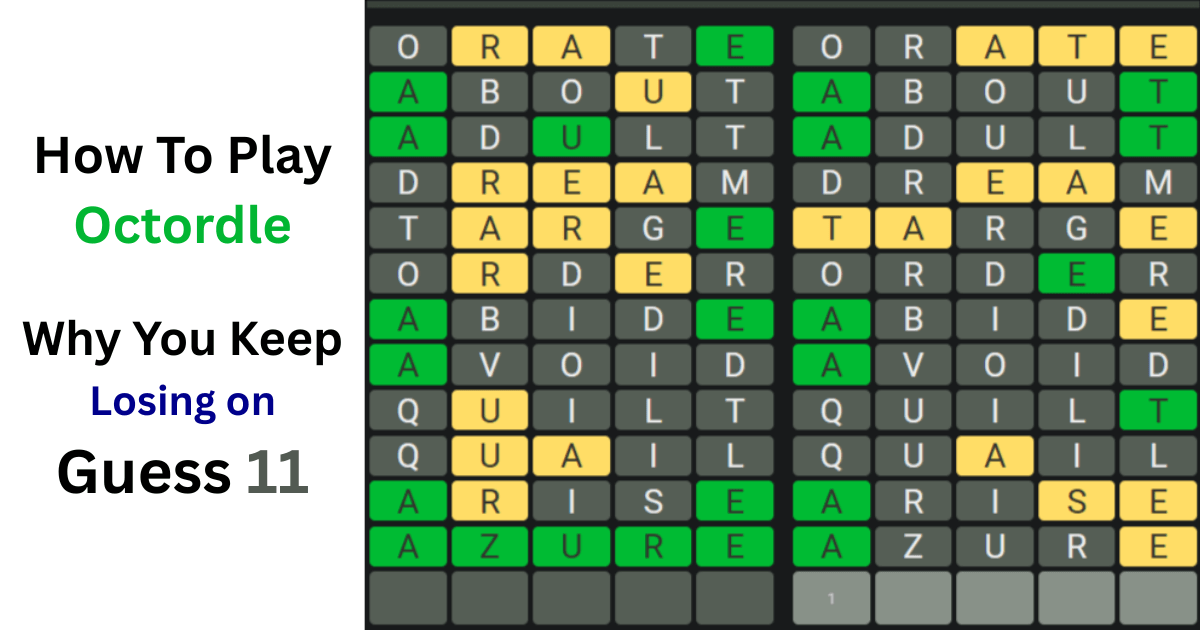
You’re on guess six. Grid three has CRANE with four greens. Grid seven has O_N with three yellows. Grid five is a complete mess.
Where do you look? Grid three, obviously. It’s almost done.
That’s the trap. You finish grid three on guess seven, feeling smart. Then guess eight comes and you realize grid five and grid seven both needed that guess. Now you’re scrambling with five attempts left for four unsolved grids.
If you’re new here and wondering how to play Octordle: it’s a word puzzle where you solve eight 5-letter words simultaneously in 13 guesses. Each guess applies to all eight grids. Green letters are correct and placed right, yellow letters are in the word but wrong position, gray letters aren’t in any word.
This is how most people play Octordle. And this is exactly why they lose.
How to Play Octordle: Start With the Right Words
Everyone obsesses over starting words. STARE, ADIEU, AROSE. Honestly? Doesn’t matter as much as you think.
What matters is your second and third words. That’s where people fall apart.
If your first word gave you two yellows on grid one and nothing else, most players will chase those yellows immediately. They’ll guess LATER or WATER, trying to place those letters.
But you just wasted a guess on seven other grids. Seven boards got zero new information.
Your second word should ignore what you found. Sounds backwards, I know. But you need information spread across all eight boards before you start solving anything. Three diverse words beats one targeted word every single time.
The Moment Everything Clicks
Around guess five or six, something happens. You stop seeing eight separate puzzles and start seeing one big puzzle with eight parts.
Grid two needs a word with R in position two. Grid six needs R in position four. Grid eight needs R in position five. You’re not solving grid two anymore. You’re solving the R problem across three grids at once.
This is when players level up. You start asking “which guess helps three boards instead of one?”
Some days this clicks on guess four. Some days it never clicks and you flame out on guess eleven wondering what happened.
When Words Hide in Plain Sight
You’ve got _OUND on grid four. The answer is obvious. SOUND, ROUND, FOUND, BOUND, WOUND, MOUND, POUND, HOUND.
Except you already used S, R, F, B, W, M, and P in other grids. They’re all gray.
The answer is HOUND but you keep second-guessing because you swear you tried H already. You didn’t. You thought about it on guess seven and picked something else.
This happens constantly. You eliminate words in your head that you never actually eliminated on the keyboard. The gray letters are truth. Your memory is a liar.
The Vowel Crisis Nobody Warns You About
Guess eight. You’ve got consonants mapped everywhere. T, R, N, S, L all placed across multiple grids. But you still can’t solve anything because you don’t know where E, A, I, O, U actually go.
This is the vowel crisis. It hits every game around the same time.
Bad players panic and start guessing random words. Good players sacrifice one guess to AGUE, AUDIO, or LOUIE just to map vowels even though these words will never be answers.
One throwaway guess that solves the vowel problem is worth more than three guesses trying to luck into the right answer.
Why Sequence Mode Tricks You
Sequence feels easier. One grid at a time, take your time, no pressure.
Then you hit grid five and realize you burned eight guesses because you were being too careful. Now you’ve got seven guesses for three grids and no room for mistakes.
Sequence mode punishes conservative play. You need to be done with each grid in two or three guesses maximum. If you’re on your fourth guess for one grid, you’re already in trouble.
The best Sequence strategy feels reckless. Take risks early. If you have three possible words and no way to narrow it down, just pick one. Being wrong on guess three is fine. Being careful and wrong on guess five is how you lose.
Speaking of Sequence mode? If you’re stuck on today’s puzzle, I keep a running list of daily Sequence answers that might save you a streak. And yes, before you ask, there’s also today’s regular Octordle answers if you’re about to throw your phone.
What You’re Not Seeing
Grid six has been U_Z since guess four. You keep trying FUDGE, BULKY, JUMPS. Nothing works.
Because you forgot about Z. Your brain filtered it out as “too rare” so you never considered FUZZY or BUZZY as real possibilities.
Here’s the other thing you’re missing. Look at what’s NOT highlighted. The empty spots.
Grid one has no feedback in position three across five guesses. That position is probably a rare letter. Grid seven has no feedback in position two. Same deal.
Common letters bias your thinking. The gaps tell you as much as the colors. You’re looking for a word with K or X or Q in that dead zone where nothing’s worked.
This is how you find answers when you’ve “tried everything.”
What Happens on Your Last Three Guesses
Guess eleven. Three grids unsolved. Your hands are sweating. This is where discipline dies.
You start guessing anything that fits. VAGUE, MAYBE, PROXY. Random words with the right letters in approximately the right spots.
Here’s what winners do instead. They pick the grid that’s closest to solved AND shares letters with another stuck grid. Solve that one first. Now you have better information for the remaining two.
Panic guessing is how you lose all three grids. Strategic triage is how you save two out of three.
When to Just Give Up on a Grid
Sometimes grid eight is cursed. You’ve tried everything logical. Nothing fits.
You have four guesses left and three unsolved grids including the cursed one.
Let it go. Solve the two you can actually solve. Take the loss on the impossible one. Finishing 7/8 beats finishing 5/8 because you wasted guesses chasing ghosts.
Nobody likes this advice. Everyone wants to solve all eight. But sometimes the math doesn’t work and you need to make a choice.
The Real Skill Nobody Talks About
Playing Octordle isn’t about vocabulary or pattern recognition or starting words.
It’s about managing cognitive load while making decisions with incomplete information under time pressure.
That sounds dramatic but it’s true.
The players who win consistently aren’t smarter. They’re just better at ignoring their instincts.
Your instinct says solve the easy grid. The winning move is usually ignoring that grid and helping the hard ones.
Your instinct says this word feels right. The winning move is checking the keyboard one more time to confirm.
Your instinct says you need a new strategy. The winning move is trusting the information you already have.
The Real Difference Between Winning and Almost Winning
You’re going to lose games where you had seven grids solved by guess nine. It’ll feel random and unfair.
It’s not random. You made a specific mistake around guess five or six that only showed up three guesses later.
Maybe you chased one grid too hard. Maybe you used a guess that only helped two boards when you could’ve helped four. Maybe you forgot to check the keyboard before committing to a word.
The gap between consistently winning and consistently almost winning is about three decisions per game. Not better vocabulary. Not lucky guesses. Just three moments where you paused instead of reacting.
Find those three moments in your next game. The urge to immediately solve a nearly complete grid. The impulse to guess without scanning all eight boards first. The assumption that you’ve already tried a letter when you haven’t.
Catch yourself once and you’ll catch yourself twice. Catch yourself twice and suddenly you’re on a win streak wondering what changed.
Nothing changed. You just stopped making the same mistake you were making blind.